
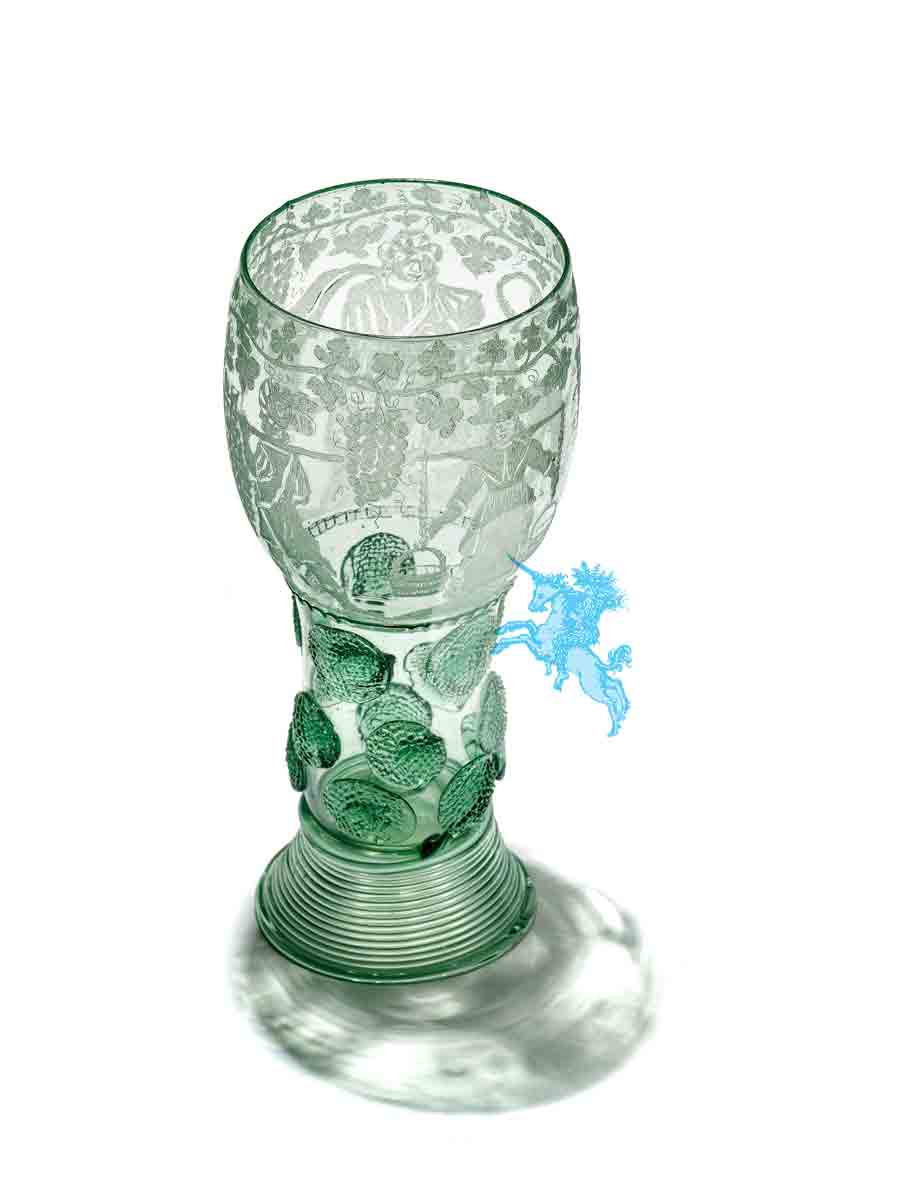
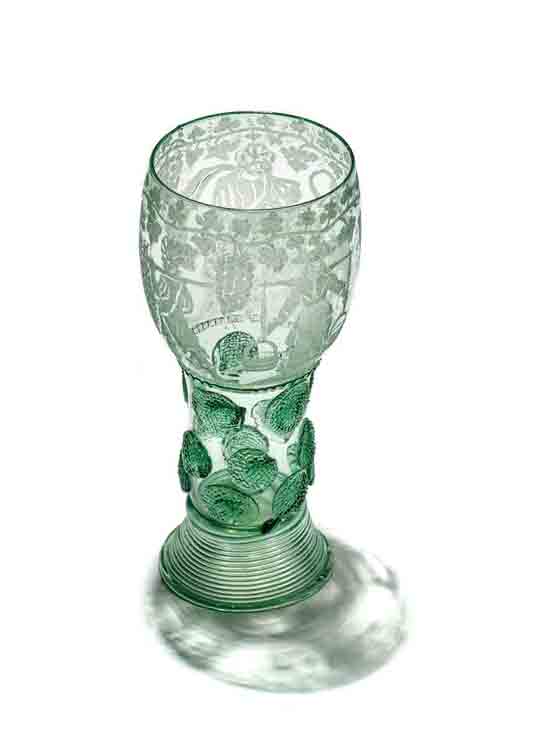
Large Romer
Dutch, dated 1676
Signed and dated ‘I. V. Moff’ or ‘Moss’, ‘1676’
Pale green glass with diamond-point engraving
Height 21 cm
Provenance: Germany, private collection
In the seventeenth century the romer was one of the most popular drinking-glasses: numerous Dutch and German still-lifes still attest to its widespread use. This type of drinking vessel was made of glass left in its natural green colour in a variety of sizes and shapes at Rhenish and Dutch glassworks. The romer studied here can be dated to 1660–1680 on the basis of its form, featuring a foot built up of a single coiled glass thread, a hollow stem studded with raspberry prunts and an ovoid bowl. Fragile as it is, this glass is remarkable not only for being in perfect condition despite its large size and thin walls, but also for the elaborate diamond-point engraving that covers the surface of the bowl with decorative configurations and figurative scenes in a stunning display of rampant horror vacui. The engravings are dated with the numerals 1676 and signed with the name of a hitherto unknown Dutch glass engraver: ‘I. V. Moff’ (could also be read as ‘Moss’). A grapevine frieze with three large pendant clusters of grapes encircles the rim of the bowl. The grape clusters subdivide the bowl of the romer into three picture fields, each of which shows a scene from the Old Testament. On one side two men, Joshua and Caleb, whom Moses sent out to ‘spie out the land of Canaan’, with the huge cluster of grapes they found there (Numbers 13: 23). Combined with the grapevines on the rim of the bowl, the great cluster of grapes from Canaan is, of course, an allusion to the function of the romer, from which wine was usually drunk. Another link to the viticulture theme is the second scene, which shows Samson fighting the lion. Samson is described in the Bible as having met a roaring lion when he went to the vineyards of Timnath to introduce to his parents the daughter of a Philistine he planned to marry (Judges 14: 1–20). In the third picture field a woman clad in seventeenth-century apparel is seen carrying two buckets on a yoke over her shoulder. This is probably also a figure from the Old Testament, most likely Rebecca carrying water from the well (Genesis 24). There the beautiful young woman met Abraham’s servant and offered to water his camels, and he in turn chose her as the bride for Abraham’s son Isaac. Like the story of Samson, who invited guests to a wedding feast after his fight with the lion, the Old Testament story of Rebecca at the Well is about wooing a bride and convivial hospitality – entirely in keeping with the function of the present magnificent romer, which was probably drunk from on such occasions. In the latter half of the seventeenth century diamond-point engraving on glass flourished in the northern Low Countries. Large beer glasses, goblets and romer were particularly suited to this type of decoration. Two types of diamond-point decoration prevailed. On the one hand, glasses decorated with calligraphy were highly prized. Such glasses featured aphorisms, verses, quotations from the Bible or other sayings in elegant inscriptions incised all over the bowl. Apart from calligraphic glass engraving, figurative decoration in diamond-point was also very popular. One master of this technique was Willem Mooleyser, who was active in Rotterdam from 1666 until 1697. Nine glasses he signed and monogrammed have survived. The diamond-point engravings on the bowl of the romer studied here do stand comparison in respect of both style and quality with Mooleyser’s extant works and some romers of similaar design are even attributed to him. However, the signature ‘I. V. Moff’ makes it clear that the present romer cannot be a work of Mooleyser’s.