
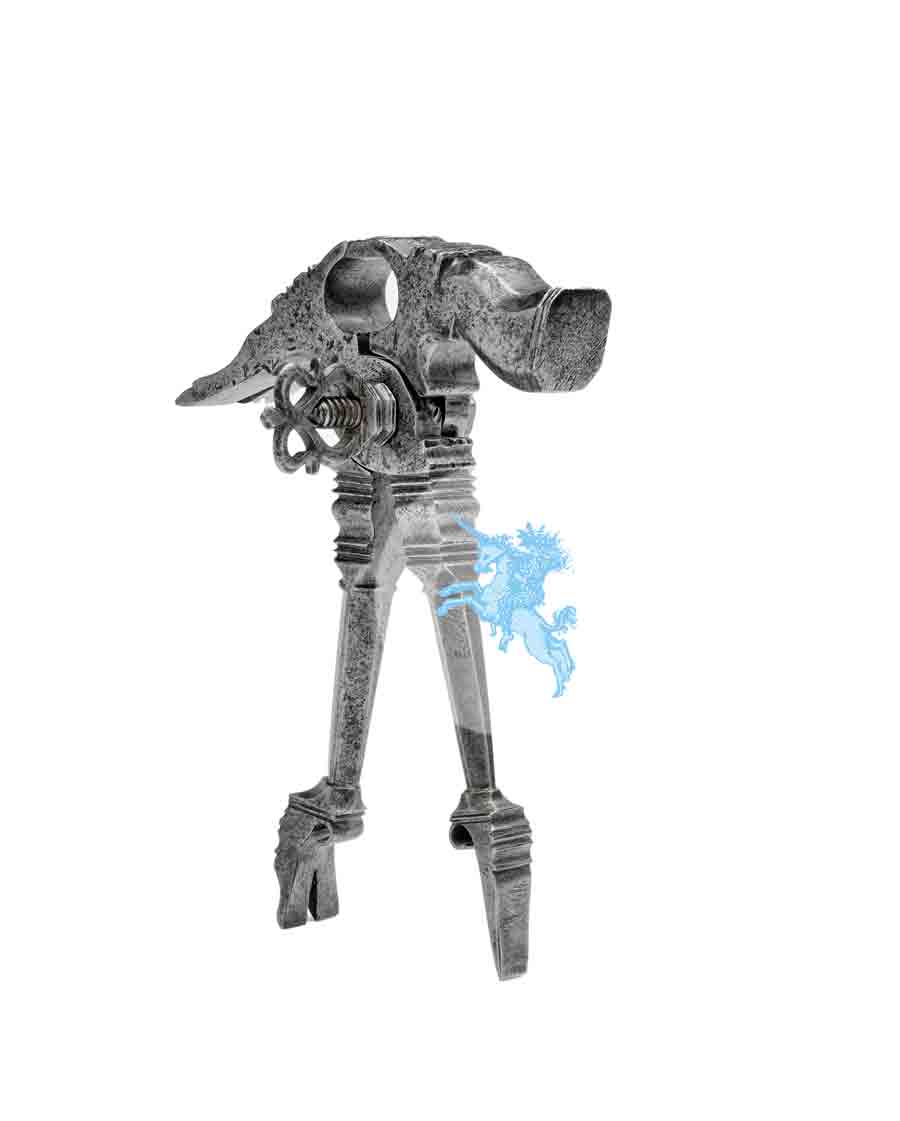
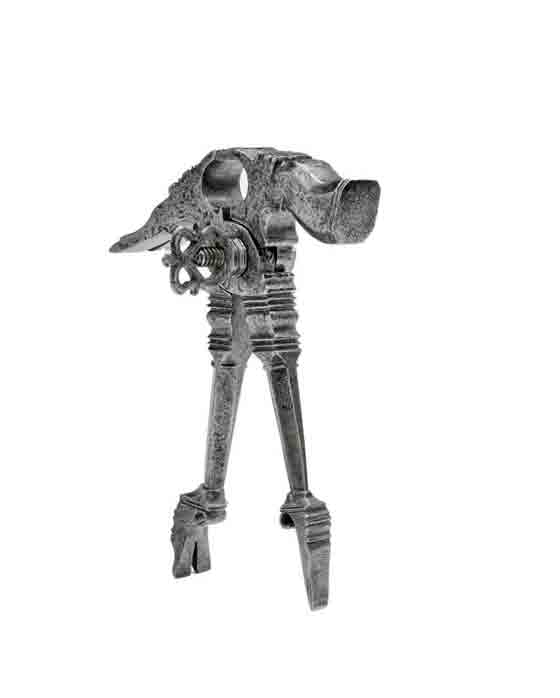
Universal combination tool
South German, Nuremberg or Augsburg, ca 1620
Steel, forged, chiselled, notched, filed
Height 21.5 cm, width 14 cm
Provenance: Germany, private collection
This unusual Renaissance combination tool is a multifunctional implement made for the owner to use with one hand. It unites the functions of a claw hammer with those of pliers and a crowbar. The basic form of this universal combination tool consists of two T-shaped shanks that are linked by a long-threaded set screw and a decorative fretwork wing nut. The lower part of each shank serves as a handle while the upper parts are designed in the form of two more tools on each side. On one side is the C-shaped pivot point that forms one of the two jaws of the pliers. On the other side, is a small hammer, specifically, a claw hammer, for pulling nails. The lower ends of the shanks can also be used as tools: at the end of one shank is a pointed chisel known as a cold chisel, used for cutting metal, and on the other another a Cat’s Paw with a V-shaped tip as an extracting notch for pulling out smaller nails. There is no need to ask which specific craft this particular combination tool was intended for since it is a functional working tool but not at all a mundane object from a craftsman’s workshop. To the contrary, the universal character of this sophisticated and expensive implement suggests a court context. It is sufficiently well known that most European Renaissance princes were passionate about working with their hands and that they are recorded as having done so. In immersing themselves in carpentry, goldsmithing, turning, machine building, metalworking and even horticulture, these princes distinguished themselves as principes artifices, that is, ‘masters of all crafts’. Thus, they expressed in symbolic terms their capabilities as rulers who shaped the territorial states and societies under their benevolent guidance ‘with artifice’ [‘künstlich”], meaning good governance, and made them flourish. One prince who was also a skilled craftsman was Augustus, Elector of Saxony (reign 1553–1586). Around 1560 he established a Kunstkammer in Dresden Castle, which he used as both a workshop and a study. By the time he died in 1586 the Electoral Kunstkammer possessed an above-average number of scientific and technical instruments and equipment. During the latter half of the sixteenth century Nuremberg was not only the capital of goldsmithing, cabinet-making and the making of scientific instruments but also working forged low carbon steel. Nowhere else in Europe was specialisation in crafts trades, especially in working iron and steel, as far advanced as in Nuremberg. By 1630 up to forty iron and steel working crafts were registered in Nuremberg: locksmiths, gunsmiths, watch makers, drill and bit makers, blade smiths, compass makers, thread cutters, etc. Outstanding exponents of those crafts trades saw themselves not only as skilled manual workers but also as mechanics and inventors who perceived themselves as engineers. However, ingeniously inventive universal tools were also made of iron and steel in Augsburg. This is attested by some of the Kunstkammer cabinets made on commission for the Augsburg diplomat and art agent Philipp Hainhofer.