
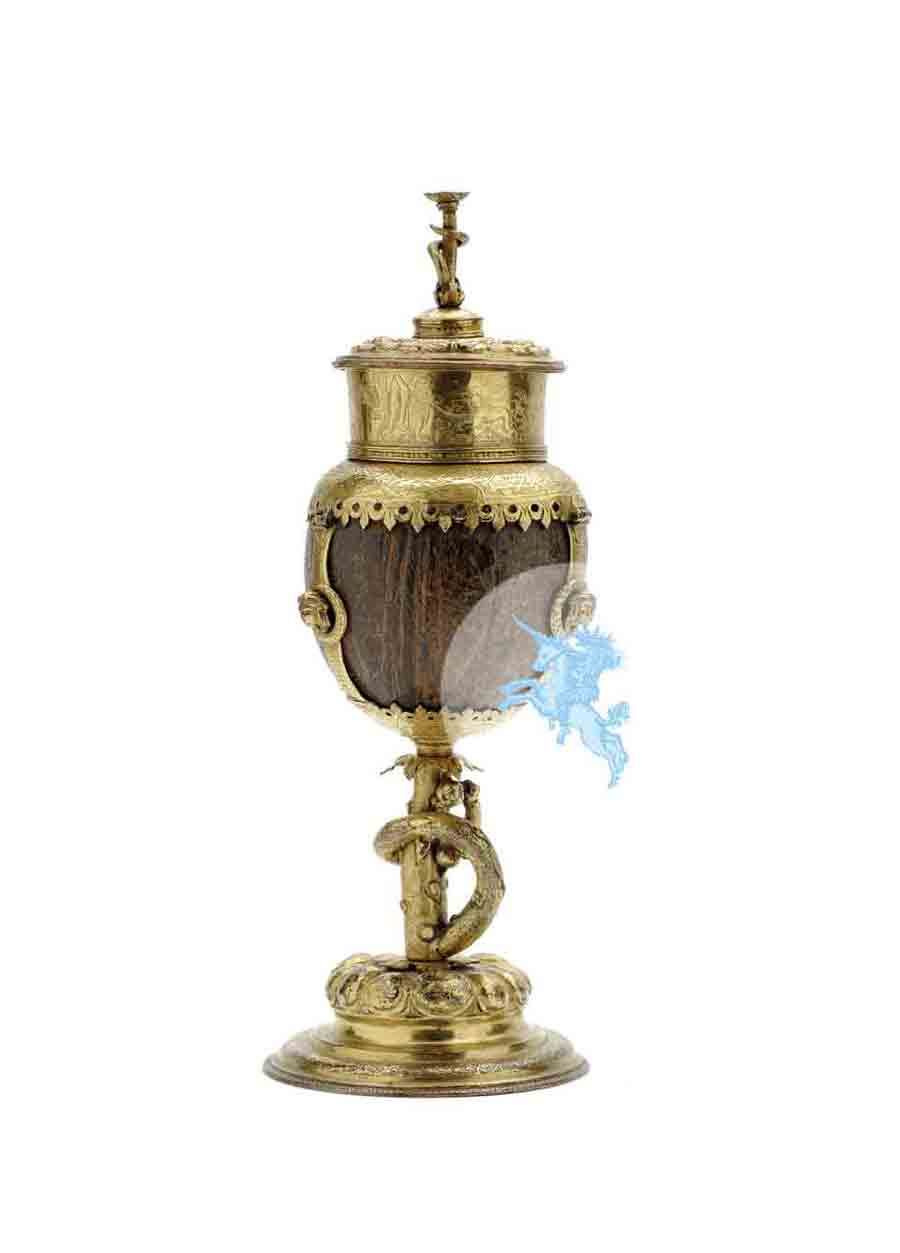

Court Coconut Cup
South German or Swiss, ca 1540-1560
Coconut; fire-gilt, chased and engraved copper
Height 26 cm, diameter at the foot 10 cm
Published in: Geistliche Schatzkammer Erzstift Salzburg. Bergbau & Gotikmuseum Leogang, Leogang 2021; Laue, G.: The Kunstkammer. Wonders are Collectable. Kunstkammer Edition, Vol. 1, Munich 2016, pp. 8-9, 24-25, 110, Cat. No. 5, Fig. 8
Exhibited at: Leogang, Gothik-Museum, “Geistliche Schatzkammer. Erzstift Salzburg”, 11.06.2021–13.01.2022
This coconut cup is characterised by an unusual form and décor, which are indicative of an early creation date around the middle of the 16th century. The stem of the cup consists of a thick gnarled trunk in an intertwined arborescent form. Fully plastic pomegranates grow out from the stem and the footplate is decorated with egg and dart ornaments. Portraits in profile have been engraved in the three round accents. The copper braces encasing the coconut are unusual on account of the three-dimensional carvings found in the middle of each of them, depicting the heads of women within laurel wreaths. The rim of the cup is engraved with a landscape scene showing a bear hunt in the forest. This scene is modelled after an engraving by Virgil Solis. On one side of the engraving, a hunter holding a spear can be identified charging directly at a bear accompanied by three dogs. On the other side, the hunter is shown standing next to the captive bear after the successful hunt. The arborescent form of the cup’s stem decidedly indicates an early dating for this piece, for this feature was typical for goldsmithing practices in the middle of the 16th century. Yet similar coconut cups from the period of 1540-60 have only been preserved in rare cases. Noteworthy are the three coconut cups with arborescent stems found today in Cologne in the Museum für angewandte Kunst, in the Kunstkammer of the Kunsthistorisches Museum in Vienna and at the Kunstgewerbemuseum in Berlin. The August Neresheim Collection in Zurich also boasts another similar coconut cup with an arborescent-formed stem and comparable footplate, which is dated to 1536 and thereby confirms the early dating of the present artwork.