
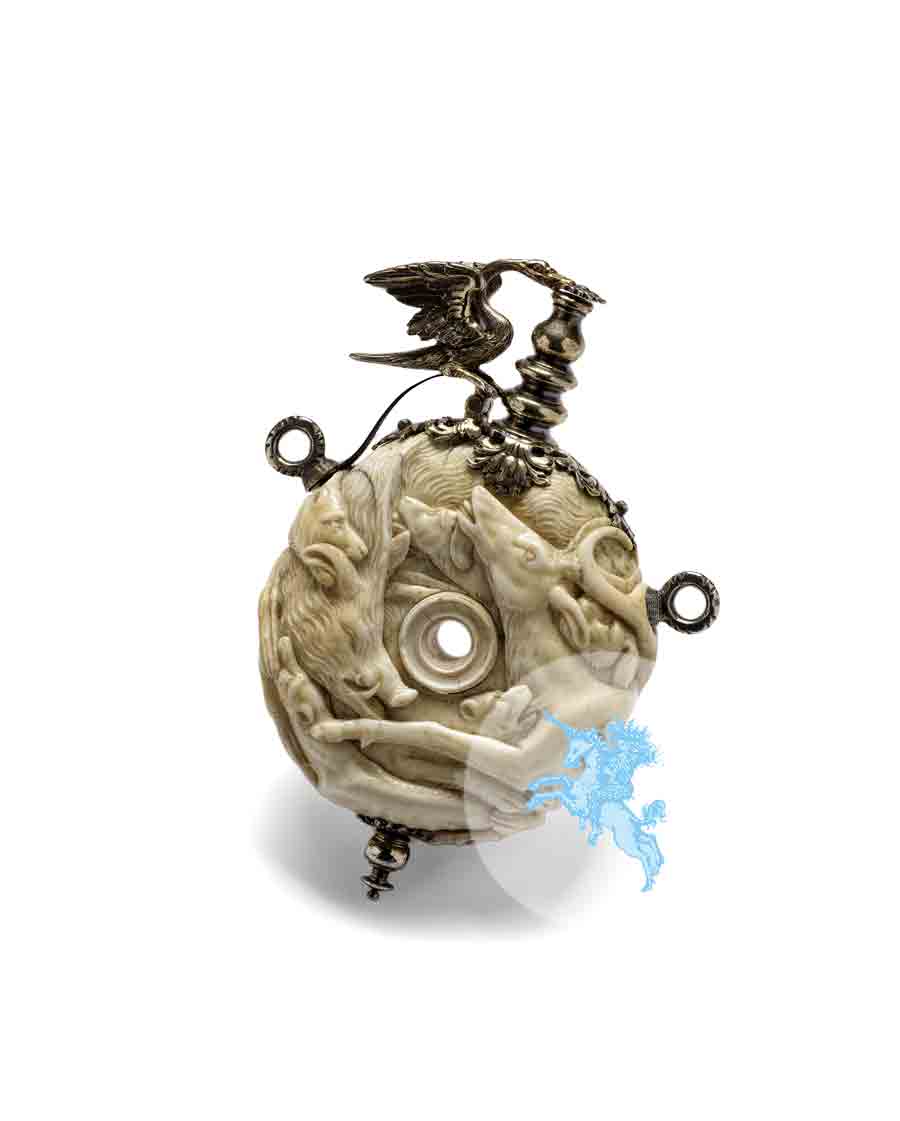
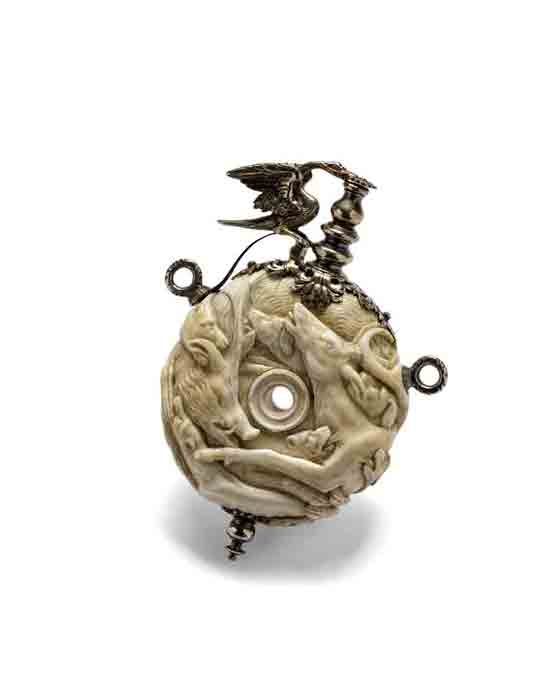
Court powder flask
Johann Michael Egner, attr.
Strasbourg, ca 1650
Ivory, turned and carved; silver, cast, repoussé, chased and fire-gilt; steel stand
Height (with charger spout and suspension lug) 17 cm, Diameter 10 cm
Provenance: France, private collection
The association of the present powder flask with hunting at court is made clear by its iconography: a roiling tangle of hunting hounds, a stag and a boar biting each other is depicted. What is striking here is the high quality of the turned and carved ivory sculpture, which is distinguished by realism, fine modelling and intricacy of detail. This superlative ivory is enhanced by an elaborate mount of fire-gilt silver, which is remarkable both for the precious materials of which it is made and the figurative modelling. The thumbpiece of the spout is a cast and chased silver statuette of a swan with outstretched wings, whose bill holds the lid of the stopper. The stopper in turn is joined to its base by a fire-gilt silver collar of sumptuous foliate decoration that encircles the mouth of the flask. Powder horns and powder flasks that are made of wood or ivory and are decorated with huntings scenes featuring a tangle of game animals and hunting dogs are traditionally attributed to the gunsmith and sculptor Johann Georg Maucher (1645–1701) of Schwäbisch-Gmünd. The key to that attribution is a powder flask of the same type in the Bayerisches Nationalmuseum, which bears the ‘MM’ monogram with which Maucher signed some of his firearms. The most recent research has, however, shown that representations of this kind consisting of entwined animal bodies hark back to another, earlier artist: Johann Michael Egner. Egner was active in Strasbourg in the mid-seventeenth century and his works were very highly prized among princely collectors. Until well into the nineteenth century Egner was regarded as one of the most important seventeenth-century sculptors; later, however, he was forgotten and has only recently been rediscovered. Research into one of his most important works, the Rothschild Olifant, which, despite having been conceived as a monumental Kunstkammer object, is related to the present powder flask, has been the paramount factor in that development. It is obvious that Egner also would have made hunting accessories such as the present powder flask considering the princely clientele he served and the symbolic importance of hunting in court circles. The Frick Collection in New York holds the ivory hilt of a hunting sword or knife, which is composed of a welter of entwined animal bodies. The elaborate ivory sculpture came from the collection owned by Augusta Sybilla of Saxe-Lauenburg (1675–1733), Margravine of Baden-Baden, and is evidently the work of the artist who made the Rothschild Olifant, that is, Egner. This double attribution proves that Egner also made hunting accessories, including hunting swords, and, presumably, also powder flasks such as the one studied here. However, even though the hunting iconography of those showy weapons and accessories suggests that they were made to be used at court hunts, the good state of preservation, the fine craftsmanship lavished on them and the costliness of the materials used to make them all indicate that these were not luxury items made for use but rather court collector’s items.