
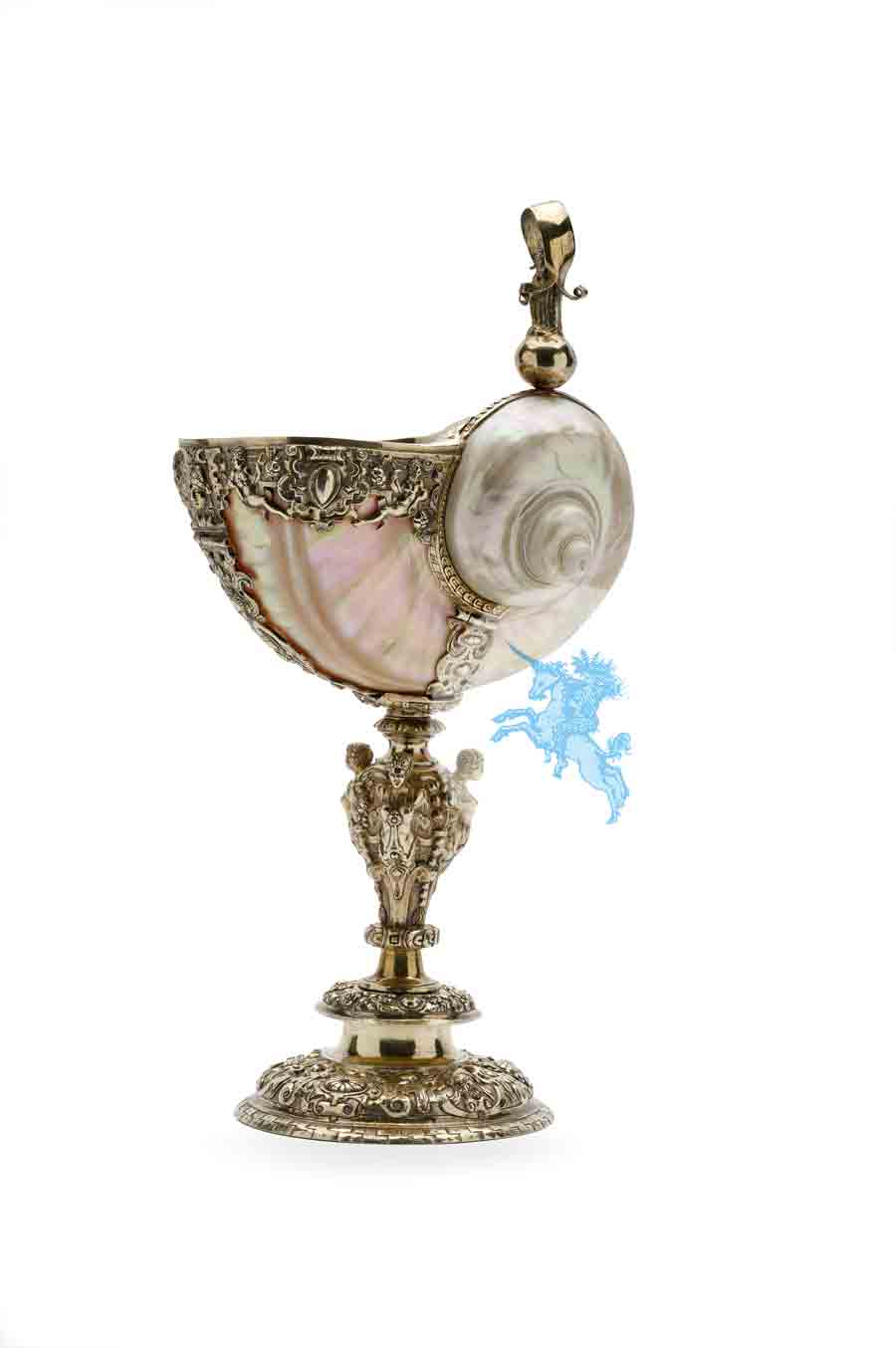
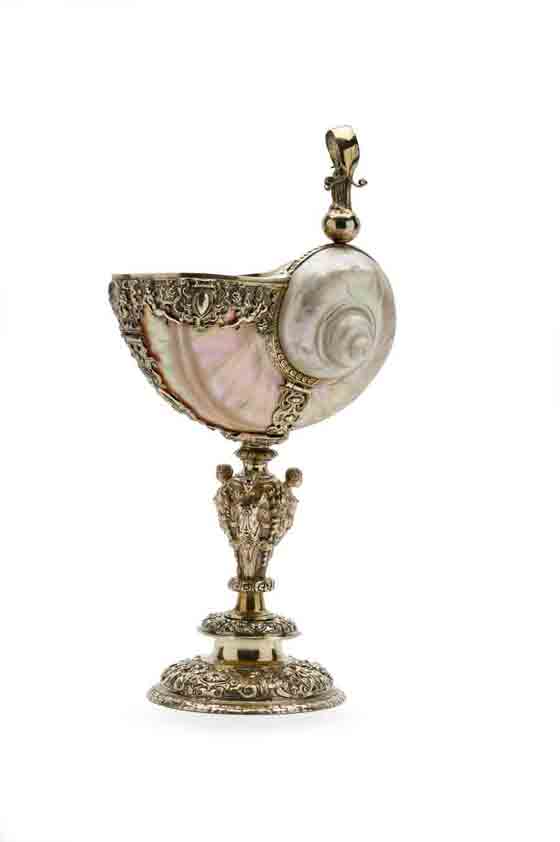
The Thyssen-Bornemisza turban snail cupl
Clawes Harders (Master 1572–ca 1610))
Lüneburg, ca 1580
Marbled turban snail shell, polished; silver repoussé, cast, pierced, punched, chased and fire-gilt; Lüneburg town mark and master maker’s mark
Height 28 cm
Provenance: Baron Hans Heinrich Thyssen-Bornemisza, Inv. No. K169c
Published in: Gold- und Silberschätze aus der Sammlung Thyssen-Bornemisza, exhib. cat. Haus der Kunst in Munich, Lugano / Milan 1989, p. 89, Cat. No. 10; Gold and Silver Treasures from the Thyssen-Bornemisza Collection, Lugano / Milan 1989, p. 89, Cat. No. 101; Г.Г. Тиссен-Борнемис / А.С. Кокс / де Пюри, С.: Сокровища из золота и серебра коллекции Тиссен-Борнемиса. Exhib. cat. State Hermitage in Leningrad (St Petersburg) and Pushkin Museum in Moscow, Milan 1986; H. Müller: The Thyssen-Bornemisza Collection. European Silver, London 1986, pp. 166–167, Cat. No. 46
Exhibited at: Munich, Haus der Kunst ‘Gold- und Silberschätze aus der Sammlung Thyssen-Bornemisza’, 19 August – 8 October 1989; Memphis, Dixon Gallery & Gardens, ‘A Baron’s Gold and Silver Treasures: The Thyssen-Bornemisza Collection’, 11 September – 6 November 1988; Fort Worth, Kimbell Art Museum, ‘Gold and Silver from the Thyssen-Bornemisza Collection”, 25 June – 21 August 1988; Omaha, Joslyn Art Museum, ‘Gold and Silver from the Thyssen-Bornemisza Collection’, 29 January – 20 March 1988; Miami, Center for Fine Arts, ‘Gold and Silver from the Thyssen-Bornemisza Collection’, 7 November 1987 – 3 January 1988; Indianapolis, Indianapolis Museum of Art, ‘Gold and Silver from the Thyssen-Bornemisza Collection’, 1987 – 1988; 1986, Leningrad (St Petersburg), State Hermitage, ‘Сокровища из золота и серебра коллекции Тиссен-Борнемиса’ (‘Gold and silver treasures from the Thyssen-Bornemisza Collection’), 10 October –2 0 November 1986
This magnificent cup is centred on the polished shell of a turban snail, the nacreous sheen of which harmonises perfectly with the fire-gilt silver mount. The latter is particularly elaborately worked and is notable for its rich decoration, which is executed entirely in the Renaissance formal idiom and is characteristic of the latter half of the sixteenth century. The turban snail bowl, which is mounted in broad, pierced-work silver straps, rises above a round foot on a stem boasting a baluster knop with the heads of three herms worked fully in the round projecting from it. The silver straps of the bowl mount take up the herm motif, with the figures carrying stylised baskets of pomegrantes as signs of sumptuous luxury. The high standard of craftsmanship is clearly apparent in the broad, pierced-work rim mount with grotesque mascarons, strapwork cartouches, allegorical figures and pomegrantes. The name of the artisan responsible for this exceptionally fine silver mount is revealed in the two silver marks struck above the foot plate in the waisted stem. The first mark with easily recognisable letter D is poorly struck yet can be identified as the master maker’s mark used by Clawes Harders (master 1572–ca 1610), who had worked as a goldsmith in Lüneburg since 1572.